Provisioner logo
Provisioner logo
search
cart
facebook twitter linkedin youtube
  • Sign In
  • Create Account
  • Sign Out
  • My Account
Provisioner logo
Provisioner logo
  • NEWS
    • Industry News
    • Supplier News
    • Case Studies
    • Recalls
    • Regulations
    • New Consumer Products
  • EXCLUSIVES
    • Newsletters
    • Source Book
    • Sponsored Insights
    • Events
    • Webinars
    • Classifieds
    • White Papers
    • Provisioner Store
    • Market Research
  • MEAT PROCESSING
    • SUSTAINABILITY
    • Processing
    • Packaging
    • Ingredients
    • Formulation
    • Food Safety
    • Special Reports
    • Commentary
  • PROFILES
    • Processor Profiles
    • Processor of the Year
    • Top 100 Processors
  • MEDIA
    • Videos
    • Podcasts
  • DIRECTORY
  • MIHOF
  • INDEPENDENT PROCESSOR
  • EMAG
    • eMagazine
    • ARCHIVE ISSUES
    • Contact
    • Advertise
  • JOIN!
Meat and Poultry Industry NewsBeef

Commentary: University of California, Davis

Gut genes may hold key to lowering methane emissions

Scientists analyze how red seaweed changes the interactions among the thousands of microbes in the cow’s gut.
By Amy Quinton
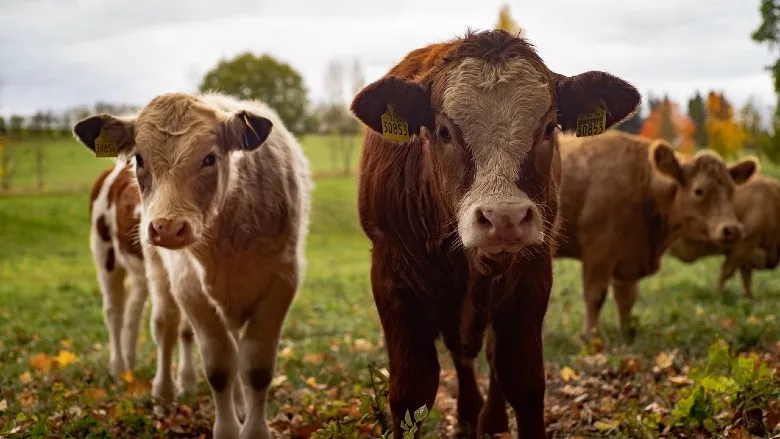
Cattle
Image by René Schindler/Pixabay
November 18, 2025

Each year, a single cow can belch about 200 pounds of methane. The powerful greenhouse gas is 27 times more potent at trapping heat in the atmosphere than carbon dioxide. For decades, scientists and farmers have tried to find ways to reduce methane without stunting the animal’s growth or productivity. 

Recent research at University of California, Davis, has shown that feeding cows red seaweed can dramatically cut the amount of methane that is produced and released into the environment. Until now, however, scientists did not fully understand how red seaweed changes the interactions among the thousands of microbes in the cow’s gut, or rumen. 

A new collaborative study by researchers at UC Davis, the University of California, Berkeley, and the Innovative Genomics Institute, or IGI, sheds light on that process and reveals which microbes in the cow’s gut might help reduce methane. The new insights bring the multidisciplinary team, composed of microbiologists, animal and computer scientists, closer to engineering the gut microbes of cows to produce less methane, offering a long-term solution that would not depend on seaweed feed additives. The study was published in Microbiome.

Seaweed transforms the cow gut

Scientists have previously shown that red seaweed of the genus Asparagopsis blocked a key enzyme found in methane-producing microbes in the cow’s gut. In the current study, researchers discovered that seaweed turned certain microbial genes on and off, a sign that these genes play a key role in how red seaweed helps cut methane from cows. As these genes switched on and off in the cow’s gut, hydrogen briefly built up. The team also identified a rumen bacterium that belongs to the genus Duodenibacillus that can use some of the hydrogen. 

“That’s important because too much hydrogen can lead to acidosis in the rumen, which can harm the animal,” said project leader and corresponding author Matthias Hess, a microbiologist and professor in the UC Davis Department of Animal Science and an IGI investigator. “Instead, this organism uses the hydrogen and converts it to succinate, a compound the animal can eventually use to make protein.”

Hess said the findings could open the door to engineering communities of hydrogen-hungry microbes that might outcompete methane-producing microbes.

“Hydrogen is a key energy source in the rumen, specifically for methane-producing microbes," said principal investigator Spencer Diamond, with the IGI. “This study helps us better understand how other microbes that naturally occur in the rumen can divert this hydrogen away from methanogens and towards bacteria that may make animals more efficient.” 

Scientists extracted fluid from the rumens of eight cows: four that were fed a regular diet and four that were also given a seaweed additive for 14 days. Cows that ate the seaweed cut their methane emissions by 60%, increased their hydrogen production by 367% and increased their feed efficiency by up to 74%.

Researchers were also able to reconstruct the genome of Duodenibacillus, a bacterium that has not yet been isolated in a lab. By looking at the bacterium’s complete genetic code, they could understand its role in hydrogen consumption, how it may compete with other hydrogen-utilizing microorganisms, and how it functions in the cow’s rumen more globally. Efforts are now underway to try and isolate this specific Duodenibacillus species for further study.

Other authors of the study include Ermias Kebreab, Pedro Romero and Breanna Roque of UC Davis; Pengfan Zhang of the Innovative Genomics Institute at UC Berkeley; and Nicole Shapiro and Emiley Eloe-Fadrosh of the US Department of Energy Joint Genome Institute. Authors Matthias Hess and Ermias Kebreab are also principal investigators at the IGI. 

This work was supported in part by Lyda Hill Philanthropies, Acton Family Giving, the Valhalla Foundation, Hastings/Quillin Fund, an advised fund of the Silicon Valley Community Foundation, the CH Foundation, Laura and Gary Lauder and Family, the Sea Grape Foundation, the Emerson Collective, Mike Schroepfer and Erin Hoffman Family Fund, an advised fund of Silicon Valley Community Foundation, and the Anne Wojcicki Foundation through The Audacious Project at the Innovative Genomics Institute. The work was also supported by the Shurl and Kay Curci Foundation and by the Office of Science of the US Department of Energy. 

KEYWORDS: emissions greenhouse gases methane research

Share This Story

Looking for a reprint of this article?
From high-res PDFs to custom plaques, order your copy today!


Amy Quinton is a news and media relations specialist at the University of California-Davis. She writes about agricultural research and veterinary sciences at UC Davis.

Recommended Content

JOIN TODAY
to unlock your recommendations.

Already have an account? Sign In

  • Double Charburger

    Premiumization drives burger category

    Shoppers seek out premium meat offerings to fulfill...
    Beef
    By: Sammy Bredar
  • JJS Adult Pekin duck

    Poultry Report 2025: Convenience propels poultry at retail

    Despite continued economic pressures, the poultry...
    Chicken
    By: Sammy Bredar
You must login or register in order to post a comment.

Report Abusive Comment

Manage My Account
  • eMagazine Subscriptions
  • Manage My Preferences
  • Newsletters
  • Online Registration
  • Subscription Customer Service
  • Connect with The National Provisioner

More Videos

Sponsored Content

Sponsored Content is a special paid section where industry companies provide high quality, objective, non-commercial content around topics of interest to the The National Provisioner audience. All Sponsored Content is supplied by the advertising company and any opinions expressed in this article are those of the author and not necessarily reflect the views of The National Provisioner or its parent company, BNP Media. Interested in participating in our Sponsored Content section? Contact your local rep!

close
  • A smiling man carrying a grocery basket is reaching down to pick up a package of meat in a grocery store.
    Sponsored byPIC

    The Green Light: New Data Shows 12-to-1 Support for Pork from PRRS-Resistant Pigs

  • Close up of a grocery cart full of groceries, a cropped image of a couple pushing the cart and a blurred background of the vegetable aisle.
    Sponsored byPIC

    New Market Research Finds Consumers in Eight Key Pork Markets Are Likely to Purchase Pork from Gene-Edited Pigs

  • Close up of a young pig with a blurred background.
    Sponsored byPIC

    New Research Forecasts Significant Economic and Market Impacts with PRRS-Resistant Pig Adoption

Popular Stories

Spam Dog

Hormel rolls out Spam hot dog for foodservice applications

Colorado Premium logo

Colorado Premium acquires Old Hickory Smokehouse

Niman Ranch Uncured Grass-Fed Beef Bacon

Niman Ranch introduces beef bacon

2026 Top 100 Meat & Poultry Processors Report

Events

June 11, 2026

From Fresh to Frozen in 3 Minutes Flat: Unlocking the Secrets to Temperature Control

Join Tony Vacaro, Foods Industry Manager, and Emile Klein, Foods Market Strategy Manager at Air Products and Chemicals, Inc. , as they tackle key questions surrounding heat removal in food processing. 

January 1, 2030

Webinar Sponsorship Information

For webinar sponsorship information, visit www.bnpevents.com/webinars or email webinars@bnpmedia.com.

View All Submit An Event

Products

Food Crime: An Introduction to Deviance in the Food Industry

Food Crime: An Introduction to Deviance in the Food Industry

See More Products
From Fresh to Frozen in 3 Minutes Flat: Unlocking the Secrets to Temperature Control Webinar Sponsored by Air Products

Related Articles

  • Cattle

    Feeding grazing cattle seaweed cuts methane emissions by almost 40%, research suggests

    See More
  • A curious cow peeks through a gate at a UF/IFAS research facility

    Feeding cows seaweed to reduce methane emissions

    See More
  • Burger King fartless burgers

    Burger King announces cows menu: an open source recipe for cows’ diet that reduces methane emissions

    See More

Events

View AllSubmit An Event
  • May 7, 2026

    Stop Plant-Floor Margin Leakage: How to Quantify and Eliminate Hidden Costs

    On-Demand WorkForge Advisor and veteran food production executive Tim Cook (Marlen International, LINXIS Group, Shick Esteve, AMF Bakery Systems) will share findings from The Hidden Costs of Inconsistent Employee Development in Food Manufacturing - research that outlines ten common, measurable, and fixable cost drivers that quietly hit your P&L.
  • June 11, 2026

    From Fresh to Frozen in 3 Minutes Flat: Unlocking the Secrets to Temperature Control

    Join Tony Vacaro, Foods Industry Manager, and Emile Klein, Foods Market Strategy Manager at Air Products and Chemicals, Inc. , as they tackle key questions surrounding heat removal in food processing. 
View AllSubmit An Event

Related Directories

  • Pennsylvania Assn. of Meat Processors

    The Pennsylvania Association of Meat Processors was formed in 1939, when a group of frozen food locker owners formed a support group. Our current members range from Processors, Slaughter, Retail, Catering, Game Processing and Suppliers in the industry. PAMP is affiliated with the American Association of Meat Processors. We hold an annual convention every May with educational classes and a supplier showcase. We would love to have you join and attend our show.
  • HBC Holdings LLC (DBA) Sadex

    HBC Holdings LLC dba Sadex is a commercial contract electron beam irradiation service center providing Ebeam irradiation to treat meat, poultry, animal feed, pet food and treats, fresh produce, and agricultural products. Sadex operates under USDA, FSIS, APHIS, and FDA regulatory authority processing food and feed products under a HACCP program to reduce foodborne pathogens to undetectable levels, extend shelf life, and eliminate harmful pests.
×

Stay ahead of the curve. Unlock a dose of cutting-edge insights.

Receive our premium content directly to your inbox.

SIGN-UP TODAY
  • RESOURCES
    • Advertise
    • Contact Us
    • Directories
    • Store
    • Want More
  • SIGN UP TODAY
    • Create Account
    • eMagazine
    • Newsletter
    • Customer Service
    • Manage Preferences
  • SERVICES
    • Marketing Services
    • Reprints
    • Market Research
    • List Rental
    • Survey/Respondent Access
  • STAY CONNECTED
    • LinkedIn
    • Facebook
    • YouTube
    • X (Twitter)
  • PRIVACY
    • PRIVACY POLICY
    • TERMS & CONDITIONS
    • DO NOT SELL MY PERSONAL INFORMATION
    • PRIVACY REQUEST
    • ACCESSIBILITY

Copyright ©2026. All Rights Reserved BNP Media, Inc. and BNP Media II, LLC.

Design, CMS, Hosting & Web Development :: ePublishing