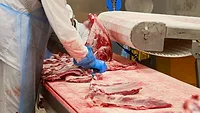
GEA expands injection portfolio for small- to mid-capacity marination lines
Machine combines configurable needle setups with a modular filtration concept intended to improve product consistency, line availability and sanitation efficiency.
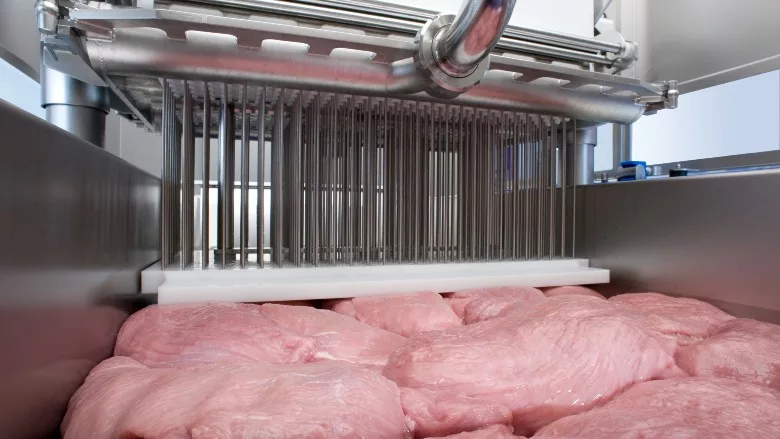
GEA MultiJector 500 with pork
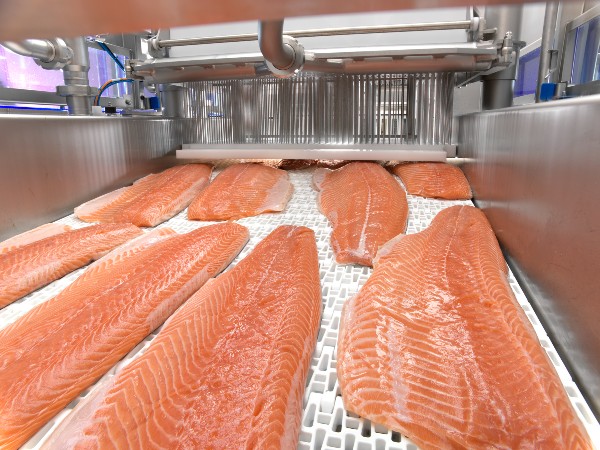
GEA Group is expanding its injection portfolio with the MultiJector 500, a new brine injection system developed for small- to mid-capacity marination lines handling ham and deli meats, bacon, poultry and fish. The machine combines configurable needle setups with a modular filtration concept intended to improve product consistency, line availability and sanitation efficiency. GEA will present the MultiJector 500 at interpack 2026, taking place in Düsseldorf, Germany, May 7 to 13 in hall 6 – booth C27.
The MultiJector 500 joins GEA’s MultiJector family and succeeds earlier systems in the 450 mm width category. It is aimed at processors looking to increase throughput, broaden their product range or update equipment in response to accurate injections to improve brine retention, stricter hygiene requirements, safety and sustainability requirements.
 Courtesy of GEA Group
Built around application-specific injection needs
At the center of the new system is an application-specific needle configuration. Processors are guided towards 2 mm or 4 mm OptiFlex needles, depending on the product and process objective. In injector technology, needle diameter and needle density determine the injection pattern — the distribution of injection points across the product surface. A denser pattern can improve brine dispersion, which is particularly important where uneven curing may lead to microbiological risks, yield loss, or inconsistent product quality. The system is also designed for relatively fast conversion between applications, allowing processors to switch product categories without extended changeover times.
“Processors in the small- and mid-capacity range are under pressure due to greater recipe variation, that results in more and shorter runs and tighter operating margins at the same time,” said Willem Poos, Product Manager at GEA. “The MultiJector 500 was developed to provide a more adaptable injection platform while optimizing the process factors that most often affect uptime, retention, and cleaning effort.”
Injection – a challenging step in the process
In industrial meat processing, injection is more than a dosing operation. It has a direct effect on product safety, yield, retention, and final product uniformity. Yield refers to the right composition of the product after further processing. Retention describes how well the product holds the injected brine during downstream stages such as tumbling, thermal treatment, or packaging. When retention is poor, processors may see drip loss or purge — the release of free liquid after injection — which affects appearance and shelf life.
The MultiJector 500 was engineered to minimize these effects through a revised drive concept, improved brine distribution, and the continued use of OptiFlex needle technology. The drive concept refers to the motion system that controls the injector head, now flexible for 2mm and 4mm execution, reducing mechanical stress on the product and supporting a consistent injection result.
Cleaner-label bacon increases demands on brine distribution
These capabilities are becoming more relevant as formulation trends shift. In bacon processing, for example, producers are increasingly working with cleaner-label formulations that reduce sodium and nitrite levels. These changes can weaken the osmotic effect, the natural movement of water and dissolved substances through meat tissue during curing. If brine is distributed unevenly under those conditions, under-curing may occur, leading to visible color differences, lower yield, and increased microbiological risk. For these applications, GEA offers a 2 mm needle option with a tighter injection pattern intended to improve distribution accuracy.
Poultry applications place filtration under greater strain
Poultry presents a different set of process demands. Because the tissue structure is comparatively delicate, protein release during processing can contaminate recirculated brine more quickly. When filtration performance is limited, needles may clog, leading to unplanned downtime and reduced line availability. To address this, the MultiJector 500 executed with 2mm needles can be configured with the module ScreenFilter of the new Modular Injector Filter, which was developed to maintain brine cleanliness in more demanding applications.
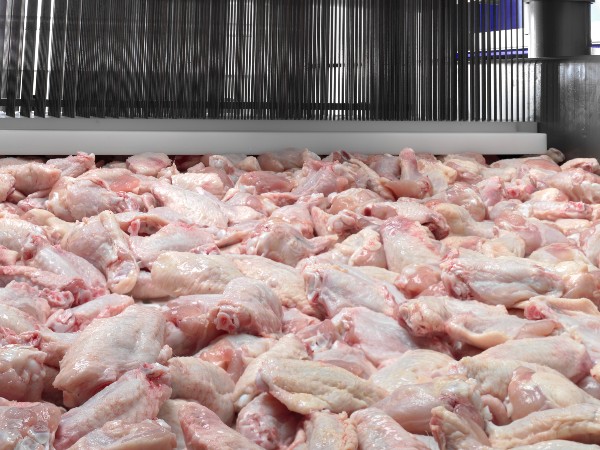 GEA MultiJector 500 with chicken wings. Courtesy of GEA Group
Filtration and cleaning move to the forefront
One of the key engineering additions is the Modular Injector Filter. Filtration plays a central role in injector performance because blocked needles can disrupt both product quality and production flow. The filter is designed for meat, poultry and seafood applications, with the selected execution matched to the product being processed.
“Filtration performance has a direct impact on process stability,” Willem Poos said. “When needles begin to clog, the consequences extend beyond maintenance. It affects injection accuracy, shift continuity, and ultimately product consistency. The modular filter concept was developed to simplify cleaning while keeping brine quality under control.”
GEA also highlights a special belt removal system that allows tool-free cleaning in less than 10 minutes. In operational terms, this is intended to reduce the burden of intermediate cleaning, which in many plants consumes labor, increases water use, and leads to unnecessary brine disposal.
Ham and deli processing calls for flexibility
In ham and deli applications, where processors often handle wider product variation and smaller batch volumes, GEA offers a 4 mm needle configuration. This version benefits from optimized height adjustment and smooth needle head movement, increasing productive time while supporting gentler product handling with GEA’s renowned stripper plate technology. The machine’s hygienic design also allows for quick rinsing between products and extreme fast exchange of needles and needle blocks, which can be particularly relevant in operations with frequent product changeovers.
Responding to current pressures in food processing
The launch comes as processors face growing pressure to reconcile product quality with leaner formulations and tighter resource management. Across meat, poultry and fish applications, recurring challenges include uneven brine distribution, under-curing, clogged needles, repeated intermediate cleaning, and time-consuming sanitation of all machine components. These issues influence not only throughput, but also water consumption, waste generation, and labor allocation.
GEA positions the MultiJector 500 as a response to those combined pressures. In one operating scenario cited by the company, uninterrupted production over an eight-hour shift — without stopping for filter cleaning or needle replacement – can save one to two hours of lost production time. Additional gains may come from lower water and brine losses and reduced dumping of contaminated brine. The patented needle block system and the further-improved OptiFlex needles are designed to be particularly robust and durable. The needles’ high mechanical strength helps extend replacement intervals and reduce associated operating costs.
The MultiJector 500 and 700 are at the heart of the line in larger GEA marination lines covering defrosting, brine preparation, injection, shaking/tenderizing, and tumbling. This allows processors to configure complete lines around specific capacity targets and product mixes rather than treating injections as a stand-alone process step.
Source: GEA Group
Looking for a reprint of this article?
From high-res PDFs to custom plaques, order your copy today!