Food Safety
Sanitation in meat and poultry plants
Effective sanitizing is crucial for reducing bacterial threats in meat and poultry plants, but employee turnover and the intricacies in developing operational guidelines have an impact on outcomes.

Meeting and maintaining high sanitizing standards can be problematic because of the difficulty in attracting, training and retaining cleaning personnel.
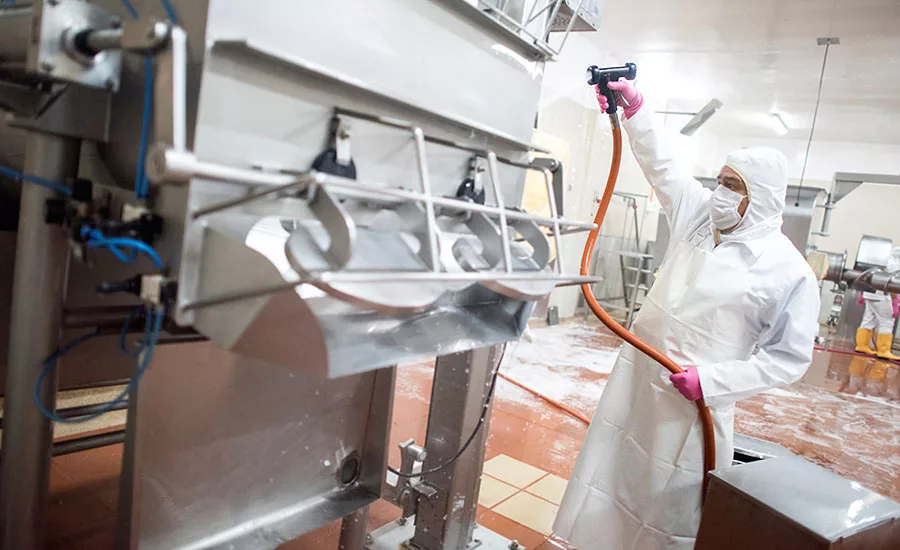
Besides fostering worker engagement, it also is imperative that operators develop clear and precise sanitizing guidelines.
The need to properly sanitize meat and poultry facilities is perhaps the most onerous undertaking for producers.
Protein plant operators not only face the never-ending battle to eradicate potential sources of foodborne illness, but they also must contend with chronic worker attrition.
“Meat and poultry is one of the most challenging food processing sectors in which to operate,” says Larry Keener, president and chief executive officer of International Product Safety Consultants LLC, in Seattle. “Companies are constantly dealing with the risk of contamination, which is inherently high in the category because of the evisceration of animals.”
To efficiently sanitize plants, workers typically must follow stringent operating guidelines that spell out the manpower and chemicals that each facility requires and pinpoint the key areas of focus, such as specific exterior surfaces and the internal components of machinery.
“There is no ‘one size fits all’ approach to cleaning meat and poultry plants,” Keener says. “It is process- and product-specific as the apparatus and line configurations in one company plant might differ from those in others, even if they are producing the same items.”
Maintaining labor
Meeting and maintaining high sanitizing standards can be problematic because of the difficulty in attracting, training and retaining cleaning personnel. Such individuals often prefer to work on production lines but, because many lack the necessary skills, are relegated to lower-paying clean-up crews. The result is a workforce with poor morale and low motivation, Keener says.
“The meat and poultry industry is in large part to blame for the high turnover by not compensating and training the sanitizing workers appropriately or conveying to them the importance that cleaning and hygienic activity has for the public’s health,” he notes. “It is a problem that can go away but the industry prolongs it by sending sanitation workers the bad message that they are second-class workers.”
Some plants have 25 percent weekly sanitizer worker attrition rates which demands constant recruiting and training, says Tim Cox, vice president of operations for Cox Consultants Inc., a Bennett, N.C.-based sanitation consultancy that works with meat, poultry and seafood operators.
“It is not like 30 years ago when most sanitizing workers came to the plants and stayed,” he says.
Other factors contributing to the high turnover are harsh working conditions and management’s failure to adequately recognize the employees’ achievements, he says.
“Sanitation workers operate in a cold environment which is also smelly, slimy and nasty,” Cox says. “They are covered with water and sweat all night long, must deal with dangerous chemicals and risk falling when cleaning tall equipment. A lot of the folks begin work at the plants without understanding that it is a horrendous job. Some don’t come back after the first day.”
Respect goes a long way
While he notes the average plant operates for 20 hours then shuts down for four hours of sanitizing, Cox says it is the level of cleanliness that sanitizing workers achieve during their shorter shift that “sets the tone” for the next production shift. As a result, it is crucial that managers focus on boosting the employees’ spirits by commending their work and responding to concerns.
“Operators must make the workers feel wanted, needed and valued and to keep them up to date on plant developments,” he says. “It helps to slow attrition, which is important because most plants don’t have enough personnel to be able to hold hands and properly train new employees every day.”
Reducing turnover also eliminates the need for companies to contract with third-party sanitizing crews. The performance of such crews, Keener says, is typically sub-par because most aren’t familiar with the nuances of each facility, including how to effectively clean specific machines.
“Outsourcing sanitizing often is a terrible mistake,” he says. “It is risky having outside contractors responsible for cleaning processing lines rather than using dedicated and trained staffers.”
In addition to helping maintain high levels of cleanliness, plants with low turnover also have safer and more efficient operations by enabling workers to consistently expand and strengthen their skills. Such competencies can range from the proper handling and storage of chemicals to the expert operation of multiple types of equipment, Cox says.
“It is important that sanitation workers are not just adequate but proficient and continuously improving, so their training should never stop,” he says. “It is particularly vital in the meat and poultry sector because the equipment is always changing. Plants get into trouble when they let their sanitation programs slide, which can occur when there are budget cutbacks.”
To further boost employee interest, it is crucial that sanitizers are told, and understand, they have the most important jobs in the plant and that management demonstrates appreciation for the workers, says John Butts, vice president of research at Land O’Frost Inc., a Lansing, Ill.-based lunchmeat supplier, and president of consulting firm Food Safety by Design.
Such acknowledgements might include serving pizza to the employees during their shift when they meet performance standards, he says.
It takes a team
Besides fostering worker engagement, it also is imperative that operators develop clear and precise sanitizing guidelines, Butts says. Input for such initiatives should come from a cross-section of plant executives, including managers from the sanitation, maintenance, food safety, engineering, production, and plant management areas.
“Teamwork creates buy-in,” Butts says. “But it boils down to defining why specific sanitizing methods are important and then teaching the appropriate cleaning processes to the workers.”
Among such functions is training employees on how to disassemble equipment for complete cleanings, a practice that Butts calls “the most critical factor for sanitation process control.” He notes, however, that companies need to track the operation as the procedure “is almost never effectively measured.”
Butts adds that “elbow grease,” rather than specific chemicals, is the key for successfully sanitizing plants.
“There are no magical chemical bullets,” he says.
Yet, while attracting, training and retaining workers and ensuring they leverage the best sanitizing practices are vital if programs are to remain strong, such elements will steadily become less of an issue as more plants replace workers with automated cleaning systems, Cox says.
Companies are increasingly adopting newer technologies to streamline activity and cut operating expenses. Initiatives include the use of online systems to monitor worker performance levels and to track the use of water, chemicals, scrubbing pads and other resources.
Such programs enable plant operators to determine the optimal number of employees necessary for sanitizing while maintaining proper inventory levels, Cox adds.
Get set for more high tech
Future sanitizing upgrades will likely incorporate high intensity or ultraviolet lights with atmospheric plasma. The technologies will more efficiently and effectively decontaminate processing equipment, surfaces and carcasses by killing bacteria and spores, Keener says.
He forecasts such designs will take five to 10 years to become prevalent because there still is a need to ensure the systems will not harm workers.
More companies also will team with community colleges to develop training programs for plant sanitizing and provide accreditation for workers, Keener says. Among the elements will be basic training in microbiology and instruction on the compounds that plants require for specific cleaning applications.
“There is a need to invest in training and to make sure the sanitizing workers realize that it takes more than picking up a hose and brush to clean the modern plant,” he says.
While it is important to have the proper equipment and cleaning compounds, it is the knowledge and performance of workers that will largely determine sanitizing effectiveness.
“Sanitation is a simple and important process but it can be difficult for companies to maintain a high performance level,” Cox says.
Yet there already are some inherent advantages for sanitation workers in comparison to other plant employees, he says. Sanitizers, for instance, can see the final results of their efforts, which may provide more incentive for them to operate up to their capabilities.
“Hog after hog go past most workers during their shifts at pork plants and the hogs are still coming in when they leave for the day,” he says. “And while the plant is an awful mess when the sanitizing starts — it looks like someone set off a bomb — the facility is clean when the workers finish and that creates a rewarding feeling.”
That attitude is essential. Crews must sustain such practices to prevent foodborne illness outbreaks, Butts says.
“The requirements for ‘clean’ are changing and we expect plants to be microbiologically clean and not just visually clean,” he says. “Leading companies recognize what that means and the bar is for cleanliness is being set higher.” NP
Looking for a reprint of this article?
From high-res PDFs to custom plaques, order your copy today!