Provisioner logo
Provisioner logo
search
cart
facebook twitter linkedin youtube
  • Sign In
  • Create Account
  • Sign Out
  • My Account
Provisioner logo
Provisioner logo
  • NEWS
    • Industry News
    • Supplier News
    • Case Studies
    • Recalls
    • Regulations
    • New Consumer Products
  • EXCLUSIVES
    • Newsletters
    • Source Book
    • Sponsored Insights
    • Events
    • Webinars
    • Classifieds
    • White Papers
    • Provisioner Store
    • Market Research
  • MEAT PROCESSING
    • SUSTAINABILITY
    • Processing
    • Packaging
    • Ingredients
    • Formulation
    • Food Safety
    • Special Reports
    • Commentary
  • PROFILES
    • Processor Profiles
    • Processor of the Year
    • Top 100 Processors
  • MEDIA
    • Videos
    • Podcasts
  • DIRECTORY
  • MIHOF
  • INDEPENDENT PROCESSOR
  • EMAG
    • eMagazine
    • ARCHIVE ISSUES
    • Contact
    • Advertise
  • JOIN!
Meat and Poultry Industry NewsSustainabilityBeef

Global initiative funds low-methane livestock breeding

Investment of $4 million supports rumen microbiome sampling and analysis.
By Industry News
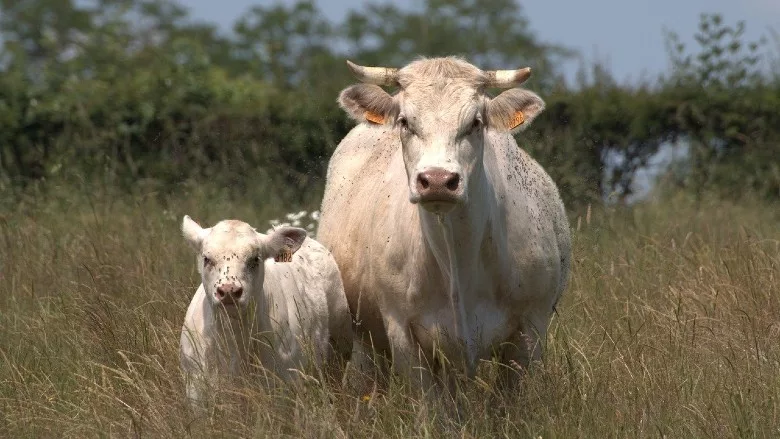
Charolais cow and calf
Image by BeautyOfAnimals from Pixabay

Charlois cow and calf

Photo courtesy of BeautyOfAnimals/Pixabay

April 8, 2025

For the first time, scientists and breeders across the globe are joining forces to slash methane emissions from livestock. Backed by $19.3 million from the Bezos Earth Fund and $8.1 million from the Global Methane Hub, a new initiative will fund research and breeding programs across North America, Latin America, Europe, Africa and Oceania to help herds emit less methane – naturally.

The funding will support grants that deliver the tools to identify low-emission cattle and sheep based on biological traits; and help breeding programs select animals that are naturally more climate efficient.

“Reducing methane from cattle is one of the most elegant solutions we have to slow climate change,” said Andy Jarvis, director of the Future of Food at the Bezos Earth Fund. “Thanks to collaboration with the Global Methane Hub, we’re backing an effort that uses age-old selection practices to identify and promote naturally low-emitting cattle – locking in climate benefits for generations to come.”

Methane is a potent greenhouse gas – more than 80 times as powerful as carbon dioxide over a 20-year period. Cattle are the largest contributors to livestock-related methane emissions. But even within a single herd, some animals emit up to 30% less methane than others. Scientists say selecting and breeding for these traits – just as farmers have done for centuries for milk yield, fertility, or disease resistance – can lead to emissions reductions across the industry.

“This initiative is a cornerstone of a broader global push to accelerate public-good research on enteric methane,” said Hayden Montgomery, agriculture program director at the Global Methane Hub. “Together with the Bezos Earth Fund, as part of the Enteric Fermentation R&D Accelerator, we’re building an open, coordinated foundation that spans countries, breeds, and species – delivering practical solutions that reduce emissions and support farmers worldwide.”

These efforts will screen more than 100,000 animals, collect methane emissions data and scale up low-emission breeding practices across public and private breeding programs.

The Bezos Earth Fund is contributing $2.34 million to the University of Nebraska to lead research on low-methane beef genetics in commercial and crossbred cattle populations in the US, and $4.85 million to the Angus Foundation to integrate low-methane traits into beef cattle breeding programs in North America, Oceania and Europe. The Bezos Earth Fund is additionally granting $8.7 million to accelerate low-emission dairy breeding across Holstein, Jersey, Brown Swiss and Red breeds, led by Wageningen University in the Netherlands, and $3.35 million to advance methane-efficient breeding in Indigenous African cattle, led by the International Livestock Research Institute in Kenya.

The Enteric Fermentation R+D Accelerator of the Global Methane Hub is contributing $1.7 million to support methane-efficient beef breeding in Latin America, led by the National Agricultural Research Institute in Uruguay, $2.4 million to accelerate low-emission sheep breeding in Europe, Oceania and Latin America, led by the University of New England in Australia, and $4 million to support rumen microbiome sampling and analysis across all above-mentioned projects funded by Global Methane Hub and the Bezos Earth Fund.

“This work brings together the best of science, industry, and the global breeding community to accelerate genetic improvement for methane efficiency worldwide,” said Roel Veerkamp, leader of the initiative at Wageningen University & Research. “It fits nicely with our mission at WUR to explore the potential of nature to improve the quality of life.”

The work is part of the Global Methane Genetics initiative, an international collaboration to embed climate-smart breeding practices into livestock programs. With support from over 50 institutions in more than 25 countries, the initiative aims to make methane efficiency a global breeding standard. Over time, this approach could cut methane emissions from cattle by 1 to 2% each year – accumulating to a 30% reduction over the next two decades.

Source: Bezos Earth Fund

KEYWORDS: breeding emissions reductions livestock methane

Share This Story

Looking for a reprint of this article?
From high-res PDFs to custom plaques, order your copy today!

Recommended Content

JOIN TODAY
to unlock your recommendations.

Already have an account? Sign In

  • A cow eating grass and a chicken standing next to it in a field.

    The Top 100 Meat & Poultry Processors of 2026

    The 2026 Top 100 Meat & Poultry Processors highlights...
    Special Reports
    By: Fred Wilkinson
  • Breaded chicken nuggets on a white plate.

    Food safety programs prioritize prevention, verification, and traceability

    Across processing operations, food safety strategies are...
    Meat and Poultry Processing
    By: Sammy Bredar
  • An open double cheeseburger on a white plate, the top bun beside it, along with a side of seasoned fries.

    How convenience is driving summer grilling innovation in 2026

    Demand for high-quality, convenience-driven formats...
    Independent Processor
    By: Sammy Bredar
You must login or register in order to post a comment.

Report Abusive Comment

Manage My Account
  • eMagazine Subscriptions
  • Manage My Preferences
  • Newsletters
  • Online Registration
  • Subscription Customer Service
  • Connect with The National Provisioner

More Videos

Sponsored Content

Sponsored Content is a special paid section where industry companies provide high quality, objective, non-commercial content around topics of interest to the The National Provisioner audience. All Sponsored Content is supplied by the advertising company and any opinions expressed in this article are those of the author and not necessarily reflect the views of The National Provisioner or its parent company, BNP Media. Interested in participating in our Sponsored Content section? Contact your local rep!

close
  •  two individuals standing by a farm gate
    Sponsored byPIC

    When PRRS Hits Home: The Chinn Family’s Story and a Hopeful Future

  • A smiling man carrying a grocery basket is reaching down to pick up a package of meat in a grocery store.
    Sponsored byPIC

    The Green Light: New Data Shows 12-to-1 Support for Pork from PRRS-Resistant Pigs

  • Close up of a grocery cart full of groceries, a cropped image of a couple pushing the cart and a blurred background of the vegetable aisle.
    Sponsored byPIC

    New Market Research Finds Consumers in Eight Key Pork Markets Are Likely to Purchase Pork from Gene-Edited Pigs

Popular Stories

Butchers processing hanging beef carcasses in meat processing plant

Meat Institute says meatpacking industry restructuring won’t lower beef prices

Kroger logo

Kroger to acquire Giant Eagle for $1.65B

Corporate headquarters groundbreaking

PS Seasoning and Pro Smoker reveal new parent company at headquarters groundbreaking

2026 Top 100 Meat & Poultry Processors Report

Events

July 16, 2026

Strengthening Food Safety Plans for Modern Processing Operations

The live webinar will explore the latest technologies, emerging risks, and practical strategies shaping food safety programs across meat and poultry processing operations. Attendees will hear from industry experts on key challenges impacting processors today, along with approaches for strengthening and updating food safety plans across their facilities.

January 1, 2030

Webinar Sponsorship Information

For webinar sponsorship information, visit www.bnpevents.com/webinars or email webinars@bnpmedia.com.

View All Submit An Event

Products

Food Crime: An Introduction to Deviance in the Food Industry

Food Crime: An Introduction to Deviance in the Food Industry

See More Products
The National Provisioner 2026 Food Safety Report

Related Articles

  • Fortifi Food Processing Systems Enriching Communities initiative graphic

    Fortifi launches global initiative to combat food insecurity

    See More
  • Cargill and Heifer launch Hatching Hope Global Initiative to improve nutrition and bolster livelihoods of 100 million people

    See More
  • News Brief Feature

    Cargill joins Global Environmental Management Initiative

    See More

Related Products

See More Products
  • meat crisis.jpg

    The Meat Crisis

  • The 10 Principles of Food Industry Sustainability

  • meat quality.jpg

    Meat Quality: Genetic and Environmental Factors

See More Products

Related Directories

  • Meat & Livestock Australia

    Meat & Livestock Australia is the marketing and research body for the Australian red meat industry. MLA's purpose is to deliver world-leading outcomes that fuel global competitiveness, sustainability and producer profitability.
  • Kansas Livestock Assn.

    The Kansas Livestock Association is a trade association representing 5,600 members on legislative and regulatory issues. KLA was formed in 1894 when a group of more than 100 Flint Hills ranchers met in Emporia to discuss cattle theft problems and unreasonable railroad freight rates.
×

Stay ahead of the curve. Unlock a dose of cutting-edge insights.

Receive our premium content directly to your inbox.

SIGN-UP TODAY
  • RESOURCES
    • Advertise
    • Contact Us
    • Directories
    • Store
    • Want More
  • SIGN UP TODAY
    • Create Account
    • eMagazine
    • Newsletter
    • Customer Service
    • Manage Preferences
  • SERVICES
    • Marketing Services
    • Reprints
    • Market Research
    • List Rental
    • Survey/Respondent Access
  • STAY CONNECTED
    • LinkedIn
    • Facebook
    • YouTube
    • X (Twitter)
  • PRIVACY
    • PRIVACY POLICY
    • TERMS & CONDITIONS
    • DO NOT SELL MY PERSONAL INFORMATION
    • PRIVACY REQUEST
    • ACCESSIBILITY

Copyright ©2026. All Rights Reserved BNP Media, Inc. and BNP Media II, LLC.

Design, CMS, Hosting & Web Development :: ePublishing