Tariffs spark fears of economic slowdown for businesses, consumers
CoBank publishes insights on the US economic outlook in light of compounding economic conditions.

Photo credit: Hannes Nevermann/Pixabay
Consumer and business sentiment regarding the US economic outlook continues to deteriorate after dropping sharply over the past few months. Rapidly worsening expectations about everything—from inflation and personal income to business and labor market conditions—are elevating concerns among business owners, investors and consumers alike.
So far, the hard data on key economic indicators like unemployment, job creation, weekly payrolls and consumer expenditures suggest the US economy remains fairly strong. Even the recent stock market pullback is a symptom of flagging confidence about the future rather than a reflection of current business performance. The question on the minds of investors, businesses and corporate boards is whether the declining expectations will soon translate into slower spending and tightening profit margins.
According to a new quarterly report from CoBank’s Knowledge Exchange, the answer to that question will likely come into view by the end of June 2025, if not sooner. Historic data suggests that declines in consumer spending begin to become apparent three to five months after a sharp decline in economic sentiment. Consumer spending accounts for about 70% of all US economic activity.
“Not including the brief pandemic-related recession, which was overwhelmed by massive government stimulus, the previous three US recessions in 1990, 2000 and 2007 were all forewarned by weakening sentiment that led to a steep decline in consumer spending,” said Rob Fox, director of CoBank’s Knowledge Exchange. “The next set of hard data from reports on retail sales and consumer spending should begin to provide some guidance as to which way the economy is heading.”
Despite a 90-day partial reprieve, the new tariff regime remains likely to increase inflation and cut economic growth, Fox said. “While the severity of the near-term effects is up for debate, the longer-term impact of capricious US trade policy is the likely loss of trust abroad in US policymaking, something that will be very hard to regain.”
Until recently, most observers viewed the administration’s tariff campaign as a short-term negotiating tactic. It now appears a primary objective is to bring more manufacturing capabilities back within US borders, which will take time. But unpredictable tariff policy could stand in the way of achieving that goal, as businesses are unlikely to invest millions of dollars based on expectations of a policy that’s subject to change at any moment.
US government affairs
With the whole country watching the impact of President Trump’s sweeping tariffs, Congress has yet to act on this economic gambit. Currently equity and commodity markets are weakening, and the patience of the American people is being tested. Many individuals and businesses are hoping to see the tax law extended. Several industries need immigration reform, and agriculture still demands a Farm Bill. The American public will ultimately demand a functioning Congress.
Grains, farm supply and biofuels
Uncertainty over trade and biofuel policy pulled corn, soybean and wheat prices down last quarter, despite the tailwind of a weakening US dollar. Trade concerns weighed most heavily on wheat prices as world buyers have multiple exporters at their disposal. US grain stocks on March 1, 2025, revealed a strong usage pace for corn and soybeans, but wheat usage continued to fall. Farmers intend to plant the largest corn acreage in the US since 2013, as corn offers the greatest margin opportunity.
Crop production expenses are expected to continue trending downward, but they remain elevated in relation to lower commodity prices. While fertilizer prices have fallen, last year’s wet fall will require heavier spring applications, and rising corn acreage signals more demand for nitrogen. Ag retailers and farm supply cooperatives head into the spring agronomy season facing labor challenges and obstacles sourcing crop chemicals from China. Growth in biologicals remains a bright spot for cooperatives.
Renewable diesel and biodiesel production has scaled back to find stability in the absence of the blender’s tax credit, pushing prices above petroleum. Domestic production was down 41% year over year for January and February 2025 as margin pressure exceeded projections. Establishment of the renewable volume obligations under the Renewable Fuel Standard and decisions on the Clean Fuel Production Credit will largely determine the trajectory of biofuels demand and production.
Animal protein
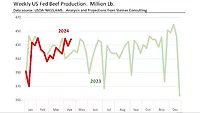
Record-high prices across the beef cattle sector remain amid continuing herd liquidation and delayed rebuilding. Despite volatility in the US cattle herd, the beef sector has been able to maintain production to meet strong consumer demand. Through the third week of March, US beef production was up slightly compared to 2024. Weekly dressed cattle weights have pushed 3 to 6% higher than a year ago, hitting a record 882 pounds per head in late January 2025. Packer margins remain squeezed as feeder cattle prices are continuing their upward trajectory.
The US pork sector is positioned for moderate growth this year, which should support hog prices and keep pork an affordable protein alternative to beef. Growing export opportunities and strengthening domestic interest in pork are moving US hog prices higher. Lean hog and cutout prices were up to start 2025, and early signs of an upward turn in the production cycle are emerging. Pork producer margins have been positive for 11 consecutive months through February 2025.
Strong broiler prices and low inventory levels are fueling optimism in the poultry sector. Production metrics have yielded a moderately favorable outlook for 2025. Chick placements are up 2.5% year to date. Breast meat prices have been on the rise. But with beef prices chasing record highs, foodservice outlets have ample incentive to center feature activity on white-meat chicken. That bodes well for broiler integrators and consumers, as the chicken segment tends to attract shoppers seeking value.
Food manufacturing
Food manufacturers are revising their sales, and earnings expectations downward as consumer sentiment has soured. Prices remain a top concern for consumers, who continue to pull back on grocery spending. More than 80% of US consumers anticipate tariffs will raise prices, with groceries expected to see the highest increases. Recognizing that more price increases could lead to volume attrition, food manufacturers are aiming to improve efficiencies and demonstrate value. Growth in private-label grocery sales, which reached record levels in 2024, is expected to continue.
Power and digital infrastructure
Surging power demand and a faster replacement cycle for aging infrastructure is causing electricity prices to outpace inflation for consumers. Even greater cost escalation could lie ahead, as critical elements of the electricity supply chain face new import tariffs and accelerating trade headwinds. Spending on delivering electricity has been increasing at the fastest clip in decades, with a growth rate of 50% over the past five years. The US power grid needs substantial investment, but with much of the supply chain imported, the price tag is rising.
The Trump administration is expected to loosen requirements for the $42.5 billion Broadband Equity, Access and Deployment program. Changes will likely include a more technology-agnostic approach to how the money is allocated, which will benefit wireless technologies. Under the previous administration, the BEAD program took a fiber-first approach to “future proof” networks built in rural America. Reduced emphasis on fiber means fixed wireless access, and low Earth orbiting satellites could play a larger role in rural America’s broadband access and accelerate connectivity.
Source: CoBank
Looking for a reprint of this article?
From high-res PDFs to custom plaques, order your copy today!