Special Report
2016 Seafood Report: Trolling for consumers
Seafood demand remains steady as consumers seek healthy and convenient options.

Mintel says that consumers are seeking premium fish that is better tasting and more nutritious, and may think that wild-caught or American-caught fish are higher quality — besides supporting the domestic fishing industry.

To help consumers make the shift to eating more seafood and reaping its health benefits, the U.S. Dietary Guidelines suggest choosing items like a salmon steak or tuna sandwich in place of meat or poultry twice each week to total at least 8 ounces of seafood each week.
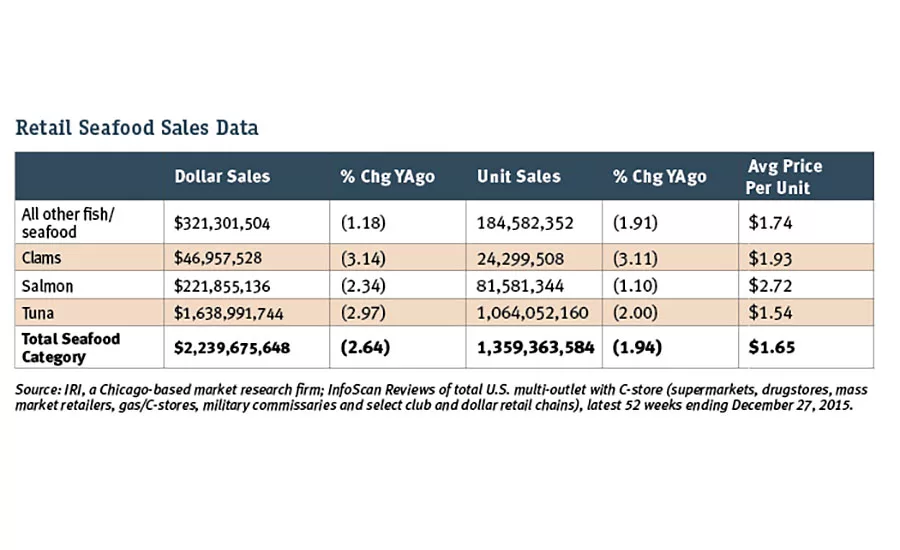
Tuna proved to be the most popular selection in the seafood category, with over a million dollars in sales in 2015.
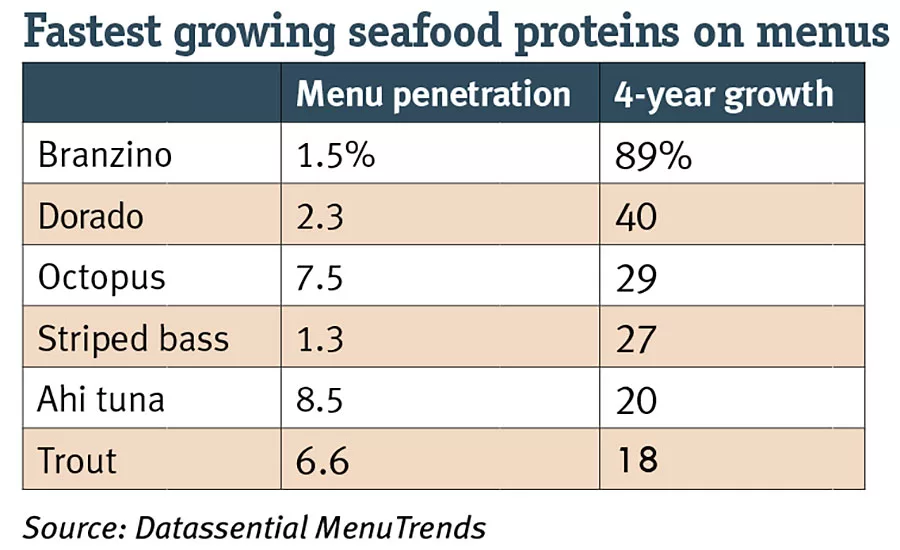
Of all the fastest growing seafood proteins being offered on menus, branzino has experienced the greatest 4-year growth.
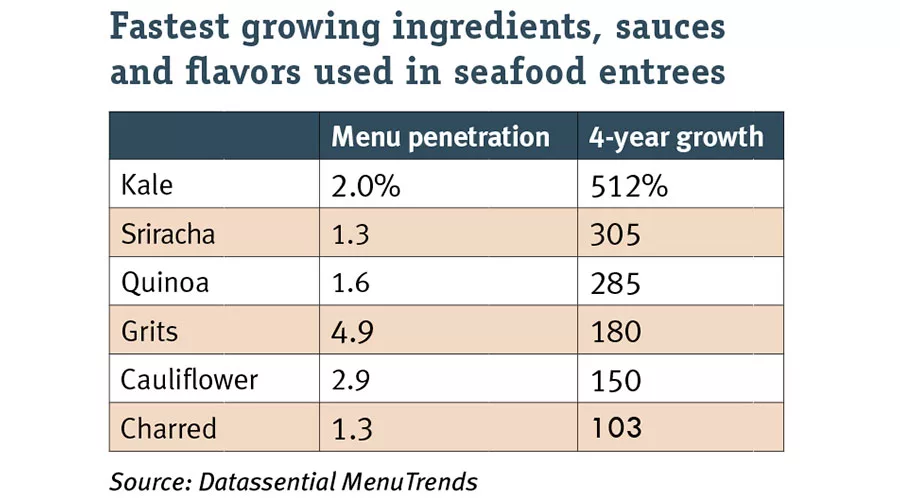
Trending ingredients are being incorporated in seafood entrees to help make seafood a bigger draw with younger consumers.
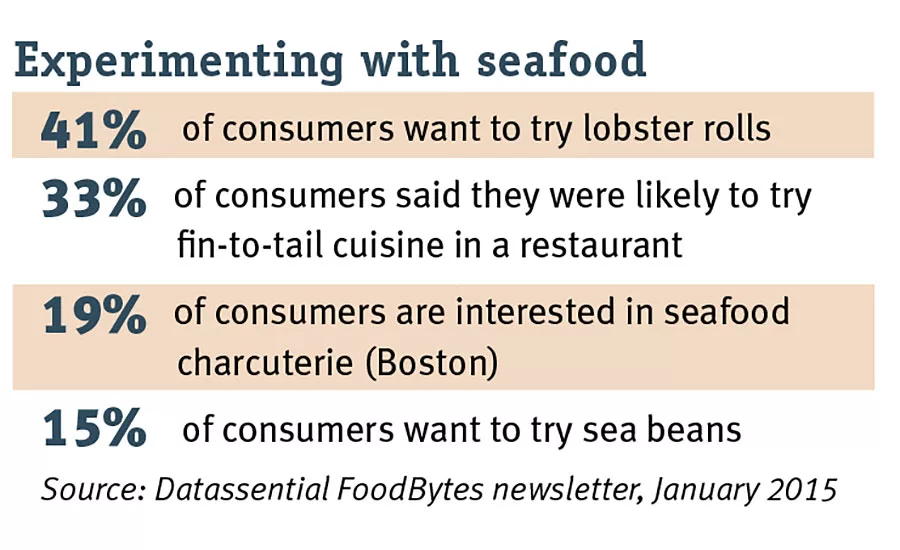
Percentages of consumers willing to try certain types of seafood.
Would Americans be a little healthier if they, say, substituted a tuna steak once a week for a NY strip steak? The government seems to think so.
The 2016 Dietary Guidelines for Americans were recently released, encouraging Americans to boost their seafood intake to at least twice a week because of its heart and weight benefits. In addition, foodservice and retailers are featuring ethnic and trendy applications more and more with seafood dishes to appeal to younger consumers.
“Demand for seafood is steady — in fact, consumption in the U.S. went up a bit last year,” says Lynsee Fowler, communications manager at National Fisheries Institute, Washington, D.C. “An increase in prepared seafood offerings — fresh, frozen and shelf-stable — have helped keep seafood top of mind for consumers at the retail level.”
According to Chicago-based Mintel’s Fish and Shellfish July 2015 report, thwe $16.7 billion U.S. fish and shellfish market is expected to grow slowly to $18.1 billion in the next five years. More than seven in 10 consumers already say they buy canned, packaged fish, seafood, fresh fish and packaged frozen fillets, and almost seven in 10 buy frozen breaded fish or seafood and fresh shellfish, says Mintel.
Price is holding back per-capita consumption as consumers perceive seafood as too expensive to eat on a regular basis, notes the report. Half or less of consumers report buying seafood once a month or more, compared to 93 percent of consumers buying beef once a month or more and 89 percent eating pork once a month or more, says Mintel.
Indeed, retailers who compete mainly on price are experiencing stagnant sales, while those that train their staff about seafood’s attributes and promote quality seafood are growing their sales, says Larry Andrews, retail marketing director, The Alaska Seafood Marketing Institute, based in Seattle.
“We see many retailers who offer serving suggestions, conduct product tastings and build creative displays,” says Andrews. “Their customers are having positive experiences and the value proposition works for them. Those who offer low-quality products at cheap prices struggle to retain customers.”
Demand for seafood should increase this winter as consumers enter the Lenten seafood selling season.
“It’s traditionally a good time to promote seafood, both at retail and foodservice,” says Andrews. “Most retailers have their promotions planned out and are ready to gain new customers as they focus on seafood during the six weeks of Lent.”
Product selection and more creative merchandising have also helped in increasing sales for many retailers, he notes.
Emphasizing health
Consumers who shop the seafood aisle are certainly influenced by seafood’s health halo: fish and shellfish are rich in essential nutrients (such as Omega-3s) and leaner than other protein options.
“Many retailers now have supermarket dietitians who help customers choose healthier options for their families — and seafood is always part of the conversation when it comes to meeting dietary guidelines,” says Fowler. “Chefs we’ve spoken to have also shared that customers love seafood because of the taste and the fact that it’s a healthier option.”
Seafood provides the most Vitamin B12 and Vitamin D, in addition to almost all of the polyunsaturated omega-3 fatty acids, eicosapentaenoic acid (EPA), and docosahexaenoic acid (DHA), notes Andrews.
So consumption of about 8 ounces per week of a variety of seafood items, which provide an average consumption of 250 mg per day of EPA and DHA, is associated with reduced cardiac deaths among individuals with and without pre-existing cardio vascular disease (CVD).
“Strong evidence from mostly prospective cohort studies but also randomized controlled trials has shown that eating patterns that include seafood are associated with reduced risk of CVD, and moderate evidence indicates that these eating patterns are associated with reduced risk of obesity,” says Andrews.
To help consumers make the shift to eating more seafood and reaping its health benefits, the U.S. Dietary Guidelines suggest choosing items like a salmon steak or tuna sandwich in place of meat or poultry twice each week to total at least 8 ounces of seafood each week.
“If executed as designed, the new guidelines, and the promotion and education that will be associated with them, will drive Americans to eat more seafood,” notes Fowler.
The guidelines also underscore the importance of pregnant and breastfeeding women eating more seafood to improve babies’ health.
“While most Americans eat an adequate amount of total protein foods, nearly all eat far too little seafood — the average American eats one serving of fish per week, while the average pregnant woman eats half a serving per week,” says Fowler.
Certainly, the guidelines don’t say that people should choose seafood over other proteins, but “the caveat is that, as we know, people aren’t eating enough seafood to meet dietary recommendations,” says Andrews. “In comparison, many people are eating more than the recommended amount of meats and other proteins, so the guidelines recommend a ‘shift’ to more seafood as a good way to balance that out.”
NFI dietitians have stressed that seafood doesn’t always need to be “center-of-the-plate,” which is illustrated in the increased retail and restaurant offerings, as well.
“For example, you can add shrimp to a pasta dish, smoked salmon to a bagel with cream-cheese or lump crab meat to spinach lasagna,” says Fowler. “Seafood is one protein that works very well as both an ingredient or the full entrée.”
Adding convenience
Value-added items, such as seafood burgers or seafood sausages, are being launched by many seafood brands to help mainstream shoppers find convenient meal solutions or products that could take the place of another traditional protein.
“One new product that comes to mind is the Alaska Pollock Burger, which is a perfect fit for consumers that prefer whitefish to say salmon and/or shellfish,” says Andrews. “There are, of course, others as well; for example, seafood sausages and other more familiar items that are created using a seafood product rather than a more typical meat product.”
Value-added items can drive incremental sales and deliver both a more positive health profile and meet consumers’ desire for easy preparation.
“Consumers who are cooking at home are asking for convenience,” says Fowler. “That’s why options like flavored tuna pouches that you can open and put right onto a salad or into a taco are very popular. Frozen options that are already flavored or breaded, that you can pop right into the oven without even needing to thaw, are also popular and, again, illustrate that consumers want to easily and quickly be able to put dinner on the table.”
Catching a wave
According to Mintel’s fish and shellfish report, about 17 percent of consumers would like to see more preseasoned or marinated products, with 11 percent requesting more ethnic flavors.
“Ethnic spices and preparation continue to be popular,” says Andrews. “Fish tacos are a favorite of consumers, especially Millennials.”
More consumers are seeking out wild-caught seafood (33 percent), American-caught fish (28 percent), American-farmed product (23 percent) and sustainable fish (20 percent), says Mintel’s report.
They are seeking premium fish that is better tasting and more nutritious, and may think that wild-caught or American-caught fish are higher quality — besides supporting the domestic fishing industry, says Mintel. Moreover, they support American-farmed fish or sustainable product to help preserve fisheries.
“Alaska Seafood has benefitted from this as sustainability of the state’s seafood resources was written into the Alaska Constitution back in 1959,” notes Andrews.
What kind of consumer is interested in a healthy, environmental and ethnically flavored product? Millennials, naturally. The seafood industry may have a slow but steady rate of growth predicted for the next few years. But Millennials are a perfect audience for the latest catch. NP
Ordering out: Seafood growth steady
More and more, seafood diners are looking for something in between Long John Silver’s and Red Lobster. Seafood continues its modest increase in foodservice, but fast-casual seafood concepts are on the rise.
Technomic’s 2015 Center of the Plate: Seafood & Vegetarian Consumer Trend Report indicates a modest increase in seafood consumption over the last two years, says Jill Failla, editor of Consumer Insights, Technomic Inc., Chicago.
“This bodes well for the seafood industry,” says Failla. “A third of consumers (34 percent) say they are eating more seafood entrées now than they were two years ago. Further, most consumers who eat seafood as a center-of-the-plate option do so at least weekly.”
Health and growing availability are two main motivators for increased consumption. “Seventy-two percent of consumers say they are eating more meals with seafood because they are trying to eat healthier, and seafood is healthier,” says Failla.
In foodservice, consumers tend to be driven by the fact they might not make seafood very often at home, so want to enjoy it while eating out.
“We see a lot of the ‘familiar favorites’ drive food service offerings, since consumers typically choose offerings they’re accustomed to (think shrimp, salmon, and tilapia),” says Lynsee Fowler, communications manager, National Fisheries Institute, based in Washington, D.C.
Menus are featuring more bold and spicy options, often in the form of a sandwich or taco, says Failla.
And, in fact, the main opportunity for seafood today is to modernize the applications of seafood.
“The current seafood items offered on menus are generally more appealing to Boomers than they are to Millennials, but the reason for this is that seafood dishes today generally feature classic preparations that don’t appeal as strongly to the younger generation,” says Jack Li, managing director, Datassential, a Chicago-based food and beverage research firm.
To make seafood a bigger draw with younger consumers, the key is to incorporate newer flavors and applications.
“We’re seeing some of this already with trending ingredients (kale, sriracha, quinoa, etc.), but there’s still much additional opportunity to further modernize seafood,” says Li. “Marketers should look to more prominently promote seafood’s use in things like tacos, poke bowls, lobster rolls, gourmet fish and chips, and other ‘hip’ foods.”
Sustainable fishing is top of mind for consumers, with 38 percent of consumers saying they prefer to eat seafood caught in the wild over farm-raised seafood.
“Underutilized fish species is something to watch more for on menus going forward, as well,” says Failla.
There is also a surge in fast-casual seafood concepts, from fish to ceviche to lobster.
“I think we can expect to see further growth in the fast-casual seafood market in the next few years, as it offers fresh and craveable yet affordable seafood options to consumers,” says Failla. NP
Looking for a reprint of this article?
From high-res PDFs to custom plaques, order your copy today!